Why wood is the building material of the future — and also the past
Wood. The oldest building material is becoming the newest.
There is something almost counterintuitive about building a house with wood in 2026. We associate construction progress with concrete, steel, and glass — materials that feel modern, industrial, permanent. Wood, by contrast, feels traditional. Artisanal, even.
But what if that instinct has it backwards?
We have been building with wood for thousands of years (for good reason).
Across cultures and climates, from Japanese timber frames to Scandinavian log houses, wood has been a primary construction material for most of human history. Not by accident. Wood is strong relative to its weight, easy to work with, and it comes from something that grows. Those properties don't become less true because we invented concrete.
What changed is scale and precision. Industrial construction demanded materials that could be standardized, mass-produced, and stacked. Concrete won that competition, so wood got pushed to the margins. Finishes, interiors, furniture were its new domain.
We think it's time to bring it back to the center.
Trees absorb CO₂. Buildings made from wood fiber keep it stored.
Cement production alone is responsible for around 8% of global CO₂ emissions. That number is easy to say and hard to picture. Here is a way to picture it: every time a concrete building goes up, a significant carbon debt has already been incurred before a single person walks through the door.
Wood works in the opposite direction. Trees absorb carbon dioxide as they grow, and that carbon stays stored in the material long after the tree has been processed. A building element made from wood fiber is, in a meaningful sense, a carbon sink — not a carbon source. This is a fundamental difference.
Wood fiber can be printed.
This is the part that surprises most people.
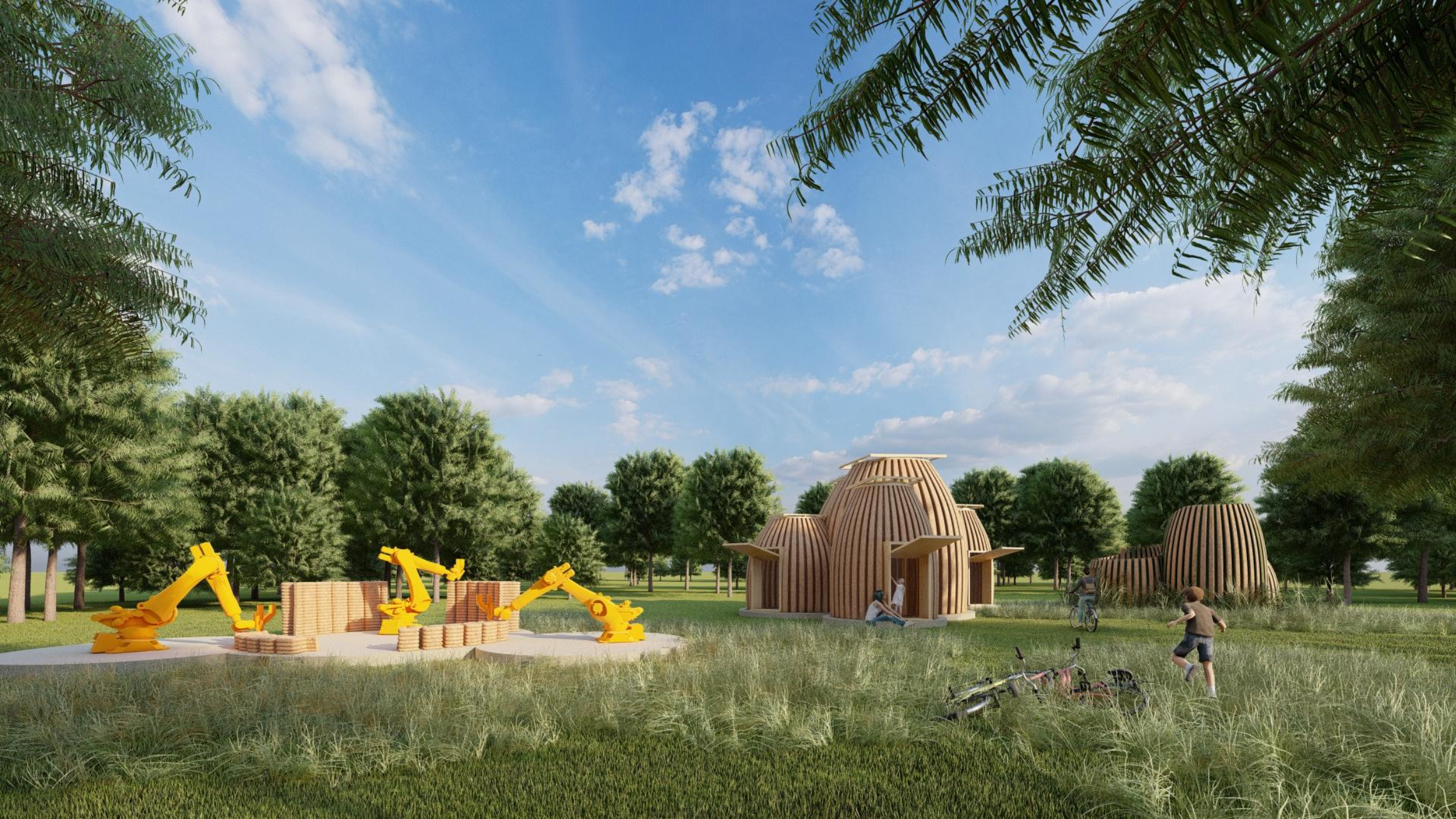
Ground down and processed correctly with other additives, wood fiber behaves like a paste. A thick, extrudable material that a robotic arm can deposit layer by layer — the same way a 3D printer builds an object, but at architectural scale. Furniture, walls, structural elements and building components of almost any geometry can be produced this way.
This is what Willowpaste is. A material made from wood fiber, developed to be printed by industrial robots into large-scale construction elements. No cement. No synthetic binders.
At the end of its life, it all goes back.
Most building materials have no plan for what happens when a building is demolished. Concrete gets crushed and downcycled at best, landfilled at worst. It doesn't biodegrade. It doesn't return to any cycle that makes sense.
Wood fiber does. A building element made from Willowpaste can be composted or recycled at end of life. The material has a beginning and an end that both belong to the natural world. That's not a small thing, it means the material was never really extracted from nature — it was borrowed.
Willowprint develops bio-based robotic construction systems using Willowpaste, a 100% wood-fiber building material. Based in Aachen, Germany.